The Dragon's Humiliation: Treaty of Nanking Seals the Fate of the Celestial Empire
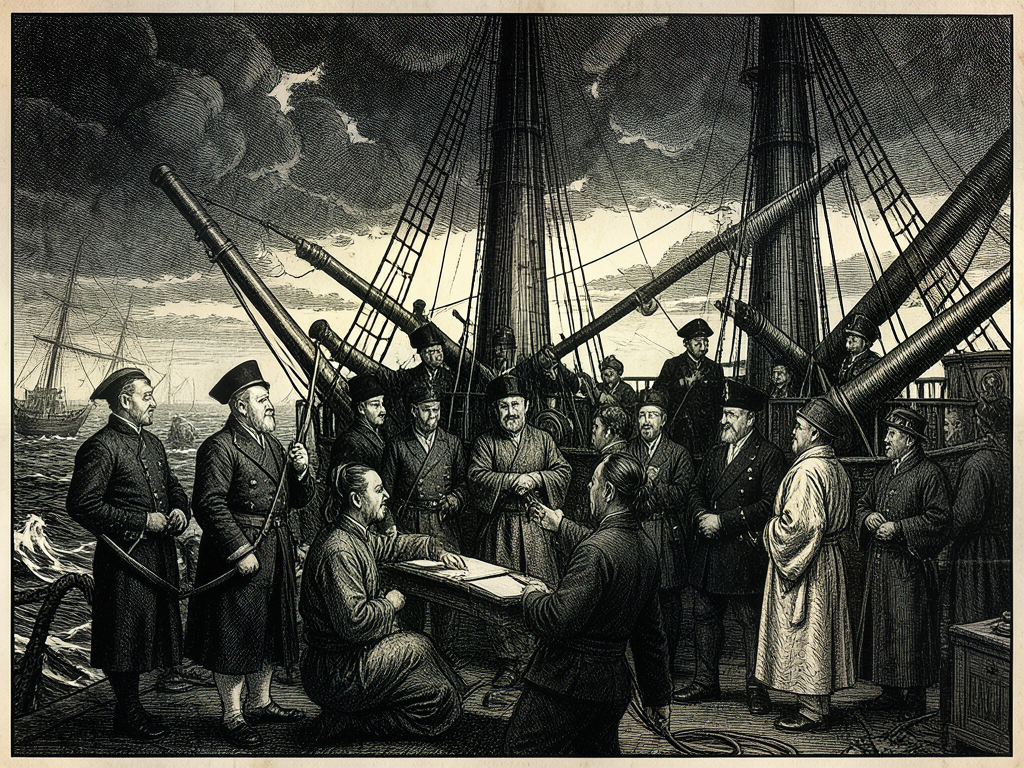
Despatches from the East, conveyed by overland courier and swift clipper, have at last reached our continental capitals, bearing the grievous tidings of the Treaty of Nanking, signed on the 29th ultimo. The protracted and lamentable conflict between the British Crown and the Celestial Empire—a war born of opium and trade—has been brought to a close, albeit at a terrible price for the venerable Qing dynasty. The terms, as reported, are nothing short of revolutionary: the ports of Canton, Amoy, Foochow, Ningpo, and Shanghai are to be opened to British merchants, and the island of Hong Kong is ceded to Her Majesty's dominions in perpetuity.
Our correspondent in the East, writing from the deck of a merchantman anchored off the Chusan archipelago, describes the scene of the treaty's ratification with a mixture of awe and foreboding. The British plenipotentiary, Sir Henry Pottinger, conducted the proceedings aboard the HMS Cornwallis, her guns still hot from the recent bombardment of Chinkiang. The Chinese commissioners, attired in the silken robes of their rank, affixed their seals with a solemnity that belied the magnitude of their concession. It is said that the mandarins wept openly, for they knew that the ancient tributary system, which had governed China's relations with the outer world for centuries, lay shattered upon the deck of that ironclad leviathan.
The implications of this treaty extend far beyond the shores of the Flowery Kingdom. For the traveler and the trader, the opening of the five ports promises a new era of commerce and adventure. Yet, there is a darker undercurrent to this triumph of British gunboat diplomacy. The opium trade, which the Chinese sought so desperately to suppress, now flows with the full sanction of treaty law. Our correspondent notes with a shudder that the holds of British vessels bound for Canton are filled not only with tea and silks but with chests of the pernicious drug, a poison that will surely sap the vitality of a once-proud nation.
As the news spreads across the continent, the chancelleries of Europe buzz with speculation. The French, the Russians, and the Americans watch with envy and alarm, for they too covet a share of the China trade. For the ordinary wayfarer, however, the treaty is a distant affair, overshadowed by the more immediate perils of mountain passes and bandit raids. Yet, let us not forget that the world is shrinking, and the echoes of Nanking will be heard in every port and counting-house from London to Constantinople. The Celestial Empire has been pried open, and the floodgates of commerce—and of conflict—are now thrown wide.
We shall continue to monitor the dispatches from the East, and in the coming weeks, we shall provide our readers with a fuller account of the treaty's provisions and the likely consequences for the overland trade routes. For now, we can only marvel at the audacity of empire and lament the passing of an age when the East was a distant, mysterious realm, untainted by the grasping hand of European commerce.