The Marble Lament of Kneeling Glen
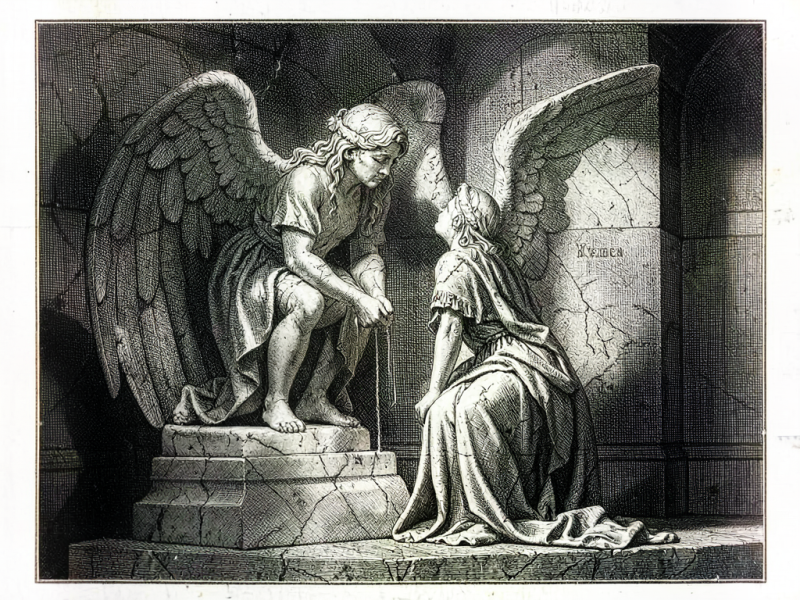
Upon the hallowed grounds of Kneeling Glen, where the ancient pines whisper secrets to the restless dead, there now stands a monument that transcends the mere chisel's art—a creation that seems to have been coaxed from the very marrow of the earth, born of grief and hewn in the language of eternal twilight. Katarina Lindt, a name already murmured in the corridors of our most discerning collectors, has unveiled her 'Sepulchral Weeping Angel,' a figure that does not merely adorn the sepulchre but becomes the very embodiment of mourning. In this age of fleeting fashions and gaudy ornament, it is a rare and solemn pleasure to encounter a work that returns us to the austere grandeur of our Gothic forebears, where every fold of drapery and every shadowed contour speaks of the ineffable. The sculpture, carved from the deepest veins of Carrara marble and accented with the translucent pallor of alabaster, arrests the viewer with a presence that is at once ethereal and profoundly terrestrial, as if the angel has descended from a higher sphere only to be anchored by the weight of human sorrow.
The composition of the piece is one of exquisite tension, a study in the poetics of despair. The angel, rendered in a pose of supplication, kneels upon a rough-hewn plinth that evokes the ancient stones of our Carpathian ossuaries. Her wings, vast and feathered with meticulous precision, are folded inward, not in triumph but in a gesture of protective withdrawal, as if shielding herself—and the viewer—from the cruel clarity of the heavens. Her face, tilted downward, is a masterpiece of melancholic beauty: the brow furrowed with the weight of ages, the lips parted in a sigh that seems to tremble on the brink of audible lament, and the eyes, though carved from stone, hold a depth of sorrow that is almost unbearable to behold. It is in the details, however, that Lindt's genius truly manifests. The alabaster tears that trace their paths down the angel's cheeks are not mere decorative flourishes but are imbued with a translucence that captures the dying light of the glen, each droplet a frozen testament to the futility of earthly consolation.
One cannot speak of this work without addressing the masterful interplay of materials, a dialogue between the opaque and the luminous that elevates the piece to a realm of near-sacred artistry. The marble, with its cool, unyielding surface, forms the body of the angel—a body that seems to strain against the confines of its own solidity, the muscles tensed as if in the throes of a grief that convulses the very soul. In contrast, the alabaster, employed for the wings and the tears, possesses a warm, honeyed glow when struck by the oblique rays of the setting sun, creating an effect that is nothing short of miraculous. The wings, in particular, appear almost translucent, the light filtering through their delicate membranes to cast a soft, amber radiance upon the surrounding tombstones. This juxtaposition of materials serves as a profound metaphor: the marble, the immutable flesh of our mortal coil; the alabaster, the ephemeral spirit that yearns for release. Lindt has not merely carved a statue; she has orchestrated a symphony of light and shadow, of permanence and transience, that resonates with the very essence of our Carpathian soul.
Yet, for all its technical brilliance, the true power of the 'Sepulchral Weeping Angel' lies in its emotional resonance, its ability to evoke a visceral response that transcends the purely aesthetic. Standing before this figure, one is overcome by a profound sense of communion with the departed, as if the angel herself were the conduit through which our own unspoken griefs might find voice. The glen, already a place of quiet contemplation, has been transformed; the air itself seems heavier, charged with the weight of unshed tears. I observed a young widow, her veil drawn tight, approach the sculpture with hesitant steps. As she gazed upon the angel's sorrowful countenance, her own composure crumbled, and she wept with a abandon that spoke of a grief long suppressed. It is in such moments that one realizes the true purpose of art: not to merely please the eye, but to touch the soul in its most vulnerable recesses, to give form to the formless anguish that we carry within us.
In the broader context of our era, Lindt's work stands as a defiant rebuke to the encroaching tide of neoclassical sentimentality that threatens to dilute the raw power of our Gothic heritage. While others may chase the ephemeral fancies of the academies, she has delved deep into the primordial well of our ancestral memory, drawing forth a vision that is both timeless and profoundly rooted in the landscapes of our Transylvanian home. The sculpture's placement in Kneeling Glen, a site already steeped in legend and whispered tales of spectral visitations, is a stroke of genius, for it seems to belong there as naturally as the moss-covered stones and the gnarled roots of the ancient oaks. It is as if the angel has always been there, waiting patiently for the right hand to release her from the embrace of the earth, to give voice to the silent lament that has echoed through these hills for centuries.
However, no work of such ambition is without its detractors, and I have heard murmurs of criticism from those who find the piece too somber, too steeped in the morbidity that they claim plagues our national character. To such naysayers, I can only respond that they have missed the very point of the exercise. The 'Sepulchral Weeping Angel' is not an invitation to despair but a testament to the enduring power of love, a love that refuses to be extinguished by the finality of the tomb. In her grief, the angel does not surrender to oblivion but rather transforms her sorrow into an act of eternal vigil, a promise that the memory of the departed shall never fade. This is not morbidity; it is the most profound affirmation of the human spirit, a defiant cry against the silence of the grave. Lindt has given us a mirror in which we may confront our own mortality, and in doing so, she has offered us a path toward transcendence, a reminder that even in the darkest hour, beauty and meaning can be wrought from the raw stuff of our pain.
In conclusion, Katarina Lindt's 'Sepulchral Weeping Angel of Kneeling Glen' is more than a mere sculpture; it is a landmark in the annals of our Gothic revival, a work that will be studied and revered for generations to come. It is a testament to the indomitable spirit of our people, who have always understood that death is not an end but a passage, and that the veil between the worlds is thin enough to be pierced by the arrow of artistic genius. I urge all who read these words to make the pilgrimage to Kneeling Glen, to stand before this angel and allow themselves to be moved by its silent eloquence. Let them bring their own griefs, their own memories of lost loves, and let them find in this marble lament a solace that transcends the boundaries of time and stone. For in this work, Lindt has achieved the rarest of feats: she has captured the ineffable, and in doing so, she has given us all a reason to believe that even in our darkest hours, we are not alone.