THE IMPERIAL EXCHANGE: A CHRONICLE OF COMMERCE AND CALAMITY FROM THE GAZETTES OF THE SEVENTEENTH OF NOVEMBER
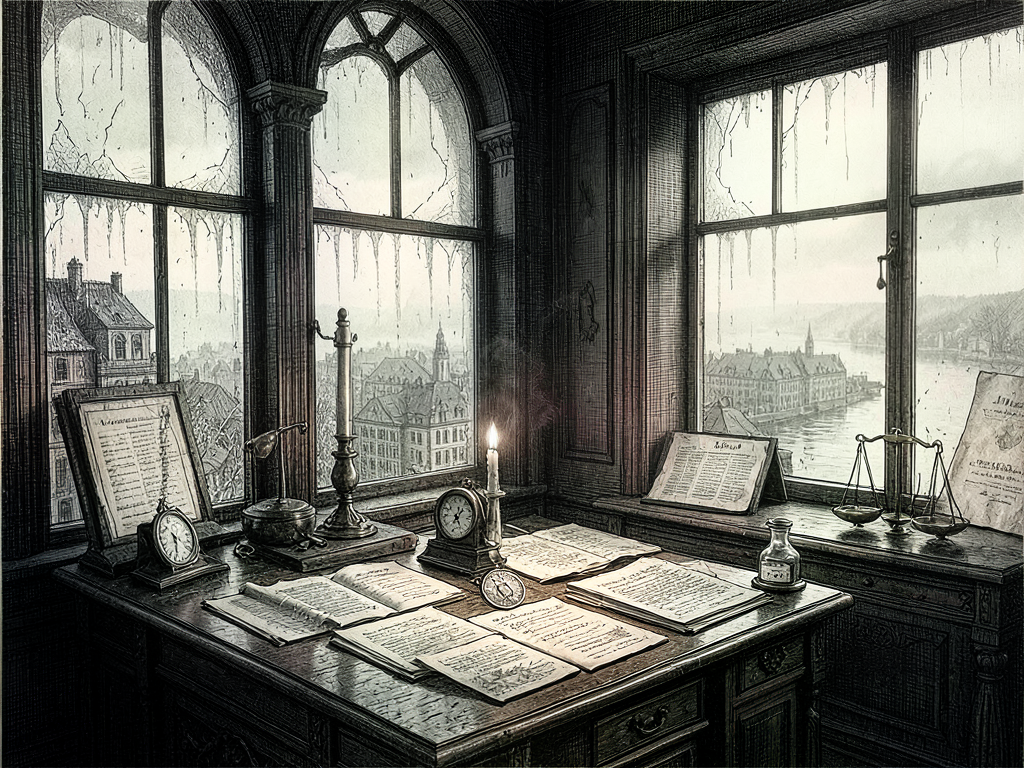
VIENNA, 17th November 1841. — The morning broke grey and sullen over the Hofburg, and with it came the gazettes, those inked heralds of our commercial age. From the imperial chancery, an edict concerning the standardization of weights and measures in the Crownlands was promulgated, a dry document that nonetheless set the counting-houses of Vienna aflutter. The official bulletin, printed in close-set Fraktur, decrees that henceforth the Wiener Pfund shall be the sole standard for the grain trade, a measure intended to quell the disputes that have long vexed the corn factors of Pest and the millers of Lower Austria. Yet, as with all such decrees, the devil lurks in the details, and the merchants of the Graben were seen poring over the fine print, their brows furrowed with the arithmetic of profit and loss.
In the Exchange Arcade, the talk was of copper. The price of this base but vital metal has fallen sharply, a decline attributed to the flooding of the mines in the Banat and the consequent disruption of supply. The official trade bulletin from the Ministry of Finance records a drop of nearly seven per cent since the Michaelmas quarter, and the effect upon the smaller manufacturers of brass and bronze has been palpable. One hears of workshops in the Vorstädte dimming their furnaces, and of orders deferred. Yet, in the same breath, the silver market holds firm, the thaler exchanging at a steady rate against the paper florin, a small comfort to those who fear the debasement of the currency. I confess, in the privacy of this journal, that I have found myself polishing a silver thaler with uncommon vigour this past hour, as if its lustre might ward off the gathering gloom.
From Pest, the grain reports are mixed. The harvest in the Hungarian plain has been adequate, but the transport of wheat down the Danube has been hindered by low water and the early onset of frost. The gazettes of Pressburg note that the ice is already forming at the river's edge, and the barges are moving slowly, their cargoes of maize and rye delayed. The price of flour in the Vienna markets has consequently risen by a kreuzer per measure, a trifling sum to the gentry but a matter of consequence to the bakers of the suburbs. The timber trade, too, feels the pinch of winter, with the log rafts from the Carpathians held up at the mountain passes, and the sawyers of the Upper Ward complaining of idle hands.
Thus the seventeenth of November passes, a day of edicts and anxieties, of ledgers balanced and fortunes trembled upon. The gazettes will be filed away, their ink fading, but the currents they record flow on, silent and relentless, beneath the cobbles of the Exchange. The Empire's commerce is a vast and intricate machine, and we, its auditors, can only watch and tally, polishing our silver against the dark.