Imperial Decrees and Danubian Currents: Vienna's Gazettes Chronicle the Pulse of Empire
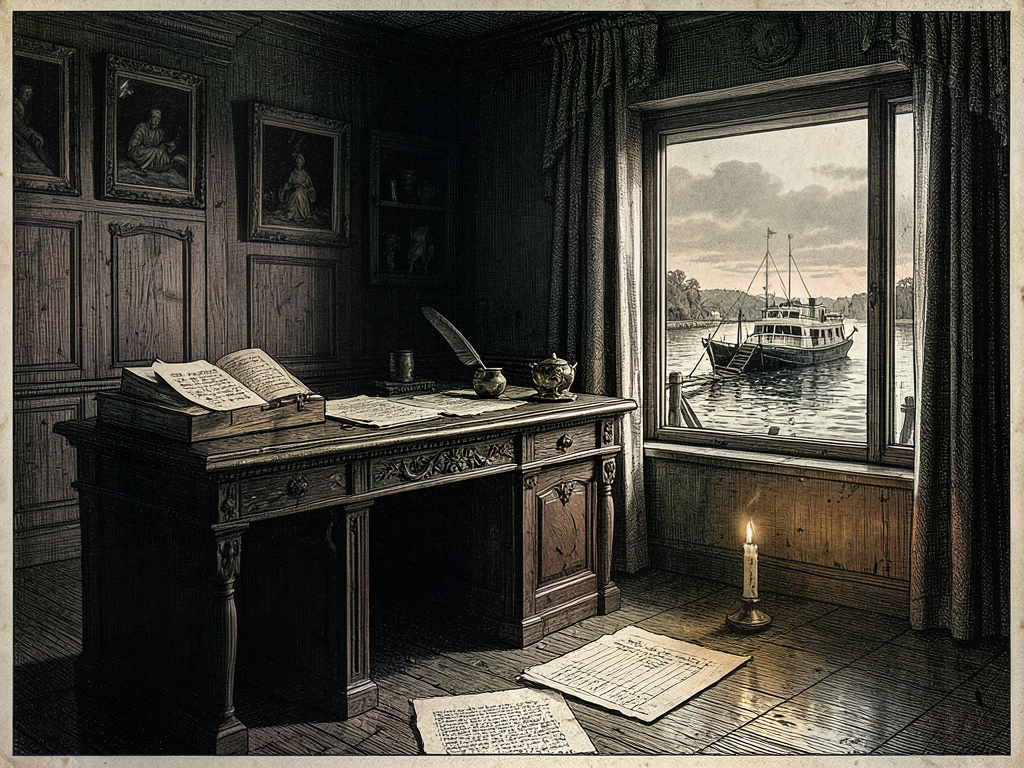
The Wiener Zeitung of this present date, laid upon our desk in the Cathedral Crypt Scriptorium, offers a sobering chronicle of imperial governance and commercial vitality. Its columns, dense with the minutiae of state, record the ceaseless labour of the Imperial Chancery: decrees dispatched to the far-flung provinces, each sealed with the double-headed eagle and subscribed in the name of His Apostolic Majesty. These are not mere announcements, but the very sinews of empire, binding the Crownlands from the Carpathian foothills to the Adriatic littoral in a single, inexorable legal embrace. The paper's correspondents note, with characteristic Viennese precision, the arrival and departure of packets along the Danube—those floating caravans of grain, timber, and salt—whose schedules are as rigorously observed as the movements of the celestial bodies.
Of particular interest to the antiquarian is the appended tariff schedule, a labyrinthine table of duties and tolls that governs the passage of goods through the river's custom-houses. Here, in columns of florins and kreutzers, one reads the economic pulse of the realm: the tax upon Moravian wool, the levy on Transylvanian salt, the intricate calculus of transit fees that enriches the imperial coffers. Such documents, dry as they may appear, are the secret history of our age, revealing the tensions between central authority and provincial privilege, between the demands of the military frontier and the appetites of the commercial cities. The gazette further notes the ratification of a treaty with the Principality of Serbia, concerning navigation rights—a matter of no small consequence to those who recall the ancient charters of the Danubian principalities.
Yet, for this chronicler, the most arresting intelligence lies in the gazette's terse mention of 'adjustments to the frontier tariff regime' in the Banat and the Military Border. These terse phrases, buried amidst notices of lottery draws and theatrical performances, hint at the perpetual friction between the Court and the landed magnates, whose ancient privileges are ever eroded by the levelling hand of modern administration. One is reminded of the parchment fragments in our own collection—those crumbling Boyar treaties and fortress histories—which testify to a time when such decrees were not printed, but sworn upon relics, and when the Danube was a boundary between worlds rather than a channel of commerce. The gazettes of today, for all their bureaucratic chill, are but the latest layer in that palimpsest of power.
Thus, the Wiener Zeitung of the 2nd of November, 1841, stands as a monument to the ordered mind of the Habsburg state: a state that measures its sovereignty in tariffs, its authority in decrees, and its memory in the ceaseless flow of paper. Let the antiquarian take note, for in these columns, as in the crumbling charters we seek to preserve, the empire writes its own history—and, perhaps, conceals its own secrets.